- Home
- Features
iService App (Coming Soon)
- Solutions
- Smart Building
- Testimonials
- About Us
- Contact Us
- Home
- Features
iService App (Coming Soon)
- Solutions
- Smart Building
- Testimonials
- About Us
- Contact Us

Shopping Malls
Kuala Lumpur, Malaysia
Tuah 1895 @ Bukit Bintang City Centre
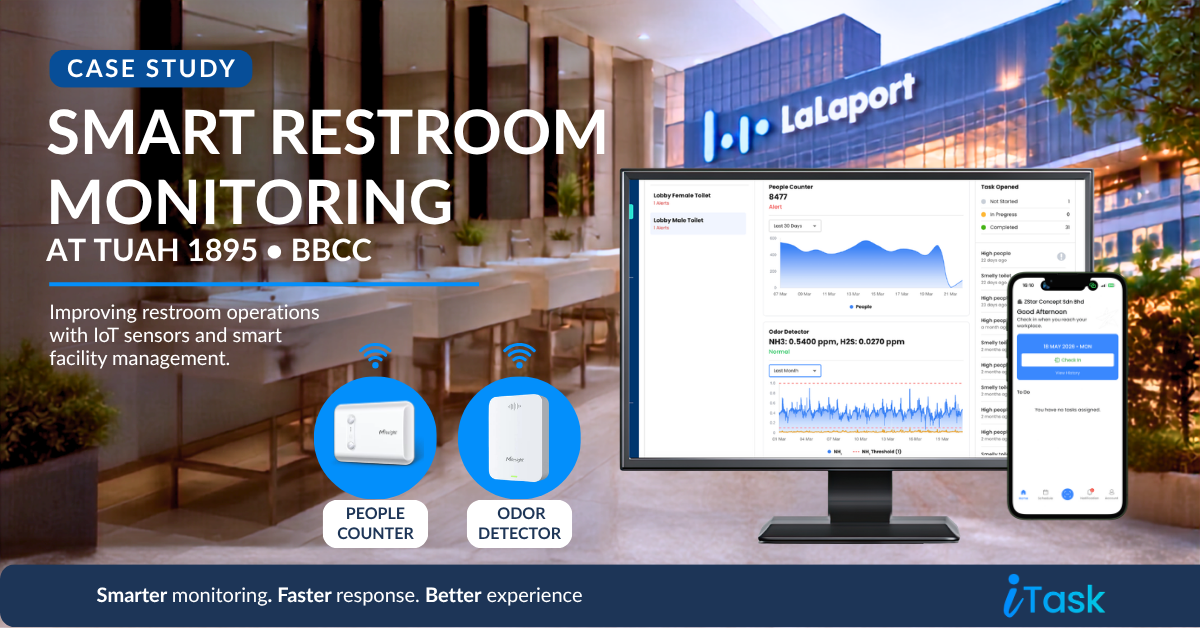
Smart Restroom Monitoring
In shopping malls, restroom cleanliness is one of the most visible indicators of overall facility management quality.
At high-traffic commercial buildings like TUAH 1895, maintaining restroom cleanliness consistently throughout the day can be operationally challenging, especially during peak shopping hours, weekends, and public holidays.
No matter how beautiful a mall looks, a poorly maintained restroom can quickly leave a negative impression on visitors. For facility management teams, maintaining restroom cleanliness consistently throughout the day is not easy, especially during weekends, lunch hours, public holidays, and peak shopping periods.
Traditional restroom inspections often rely on fixed cleaning schedules or manual checking rounds. While this method has worked for years, it also creates several operational challenges:
To improve operational visibility and response efficiency, the team at Tuah 1895 implemented a smart restroom monitoring solution powered by the iTask facility management platform with IoT sensor integration.
This allowed the facility team to move from reactive cleaning to a more responsive and data-driven approach.
Shopping malls experience unpredictable restroom traffic throughout the day.
During peak hours, restroom conditions can change very quickly. Higher foot traffic often leads to:
Previously, restroom monitoring depended heavily on routine inspection rounds and manual reporting. While cleaners were performing regular checks, supervisors still lacked real-time visibility into actual restroom conditions.
The challenge was not about whether the cleaning team was working hard.
The challenge was visibility.
Without live data, teams could only react after a complaint was raised or after scheduled inspections were completed.
The facility management team wanted a smarter way to:
That was where smart restroom monitoring came in.
To improve daily restroom operations, Tuah 1895 implemented the iTask smart facility management platform integrated with:
Instead of relying entirely on fixed cleaning schedules, the system now provides real-time restroom monitoring based on actual restroom conditions and usage patterns.
The implementation combines IoT sensor data with the iTask SaaS facility management platform.
Here’s how the workflow operates:
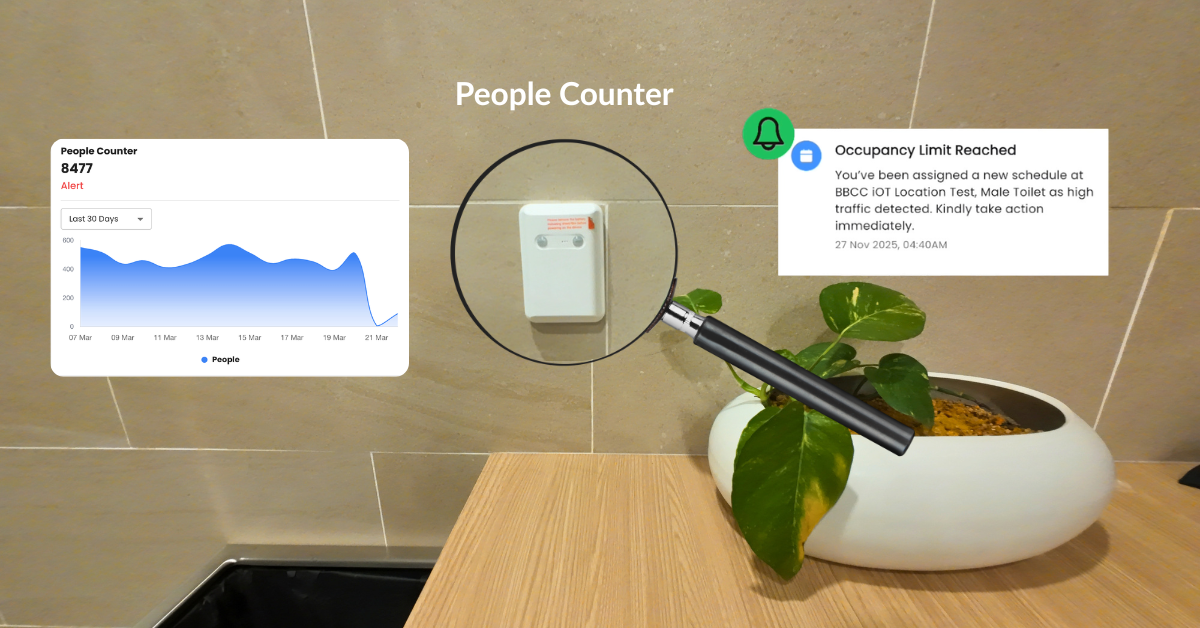
People counter sensors track restroom traffic volume throughout the day.
This helps the facility team understand:
Instead of estimating restroom usage manually, supervisors can now monitor actual traffic data in real time.
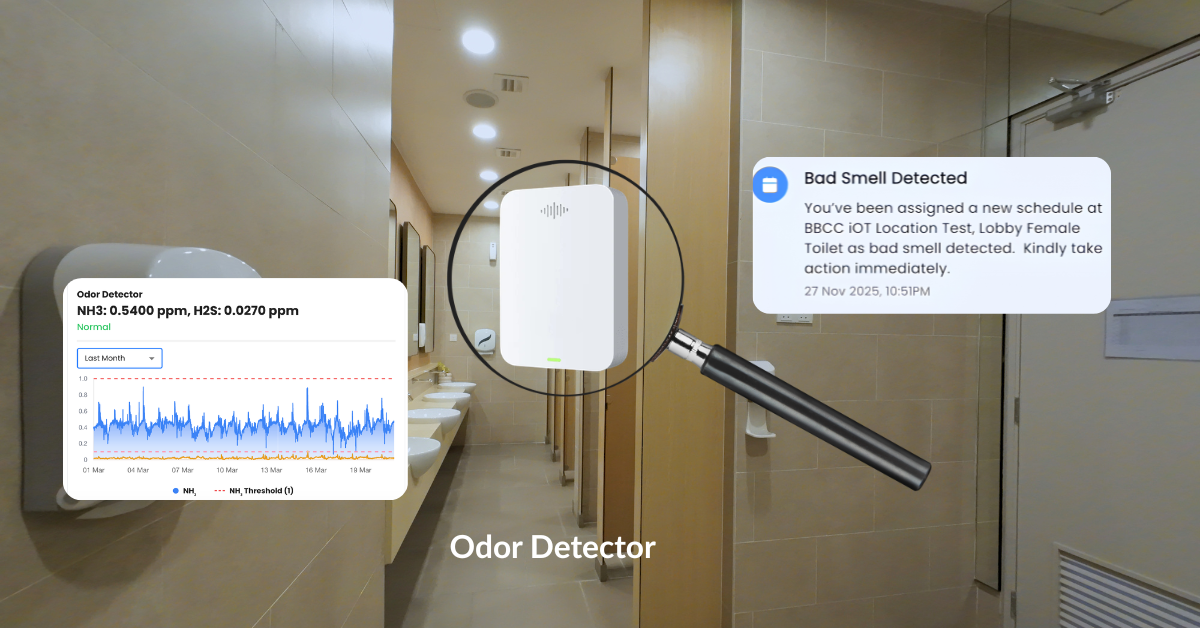
Odor detectors help monitor restroom environment conditions in real time.
When odor levels exceed predefined thresholds, alerts can be triggered automatically through the iTask platform.
This allows cleaning teams to respond based on actual restroom conditions instead of relying purely on routine schedules.
One of the biggest operational improvements came from centralized visibility.
With iTask, supervisors can monitor restroom conditions through a centralized dashboard while cleaning teams receive updates and task notifications digitally.
This creates a faster operational response cycle:
Instead of waiting for complaints, teams can respond earlier and more efficiently.
Many facilities still depend heavily on time-based restroom cleaning schedules.
For example:
The problem is that restroom usage does not follow a fixed pattern.
Some periods may require immediate cleaning attention, while other inspection rounds may be unnecessary.
By combining sensor monitoring with operational workflows, the facility team can make better decisions based on actual restroom conditions.
This helps improve:
Most importantly, it supports a more consistent restroom experience for visitors.
Supervisors can monitor restroom conditions and usage trends more effectively without depending entirely on manual reporting.
Real-time alerts allow teams to respond more quickly when restroom conditions require attention.
Cleaning resources can be allocated based on actual restroom usage instead of fixed assumptions.
Historical data helps management teams analyze traffic patterns, peak periods, operational trends, and cleaning response performance. This supports long-term operational planning and optimization.
Clean and well-maintained restrooms contribute directly to overall customer satisfaction within shopping malls and public facilities.
Across Malaysia, more facility management teams are exploring smarter building operations.
Shopping malls, airports, hospitals, office towers, and commercial buildings are increasingly adopting technologies that improve:
However, successful smart restroom monitoring is not only about installing sensors.
The real value comes from connecting operational data with daily workflows and response management.
That is where a centralized SaaS platform becomes important.
At iTask, the focus is not only on hardware installation.
The platform is designed to help facility management teams manage operational workflows more effectively through:
By combining software workflows with sensor data, facility teams can make faster and more informed operational decisions.
As shopping malls continue to handle increasing visitor expectations, restroom operations can no longer depend entirely on manual inspections and fixed schedules.
The implementation at TUAH 1895, Bukit Bintang City Centre shows how smart restroom monitoring can help facility teams improve visibility, optimize cleaning response, and support better operational efficiency using real-time data.
For modern facilities, smart restroom monitoring is no longer just a technology upgrade.
It is becoming part of smarter daily operations.
Discover how iTask helps shopping malls, commercial buildings, and facility management teams improve operational visibility with: